
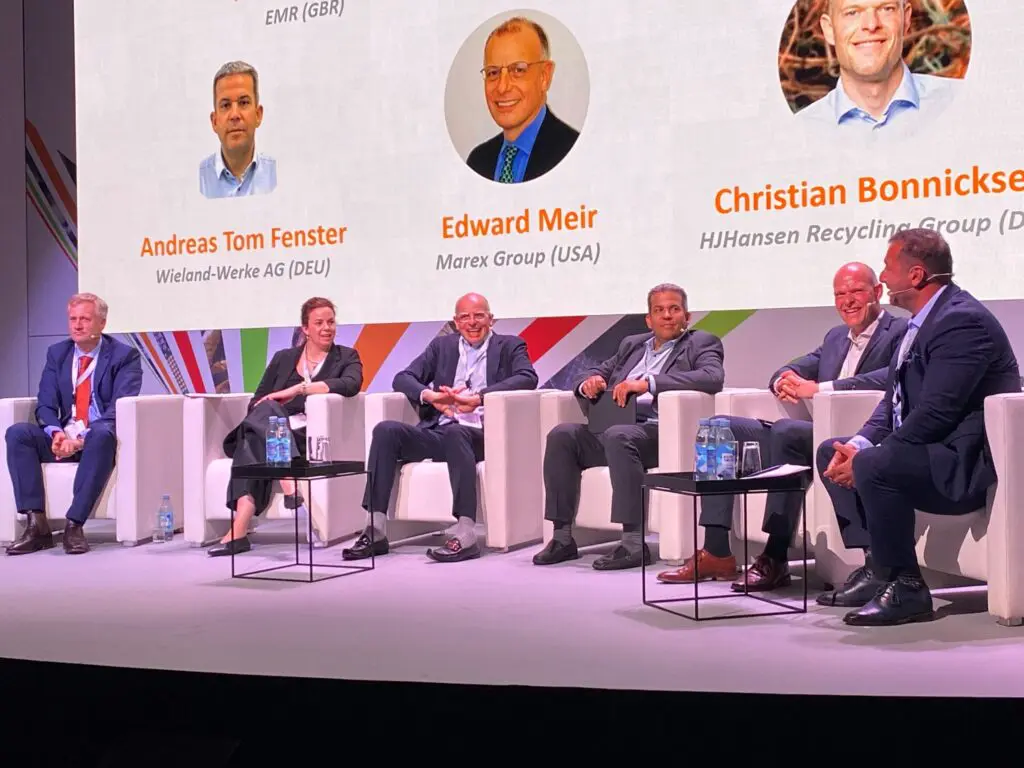
The soaring price of copper, growing protectionism and claims of Chinese stockpiling dominated the non-ferrous session at BIR’s Copenhagen convention.
The market scene was set out by Edward Meir, independent consultant to Marex, who said a recent ‘explosion’ in the price of copper was caused by a confluence of factors including mining issues, aggressive fund buying (funds now account for 60+% of client volumes) and greater demand around electric vehicles (EVs) and AI.
On the other hand, Meir said, although aluminium hit a two-year high in May, the metal had not seen the same strong buying as copper because it was less impacted by developments in EVs and AI and the far greater number of aluminium producers globally alleviated concerns of a squeeze.
‘People are talking of 15 000, 20 000, even 40 000 dollars for copper; I wouldn’t rule anything out,’ he said. ‘Markets are very tight across the supply chain. Scrap is not coming out, which is usually the case.
‘Prices will remain firm this year and could even move higher. My feeling is that copper will become like a Bitcoin trade and people will start piling in to it because of all this AI hype.’
Free trade
During questions, the panel considered free trade, a core belief for BIR. Meir said trade was becoming increasingly regionalised.
‘I will push back a bit on free trade. In theory it sounds great but what has been happening is that governments around the world are becoming more protectionist. It means scrap cannot flow as freely as before – and other products – because everyone is putting tariffs on.
‘Governments are moving away from free trade and that’s very bad – for growth and the world economy – but it is what it is.’
Christian Bonnicksen of HJ Hansen Recycling Group in Denmark was concerned that where regulations were imposed, they were often unclear. ‘One country thinks it can do it one way, another country does it another way. Even in Europe it makes it difficult to trade with each other because of EU regulations.’
Audits
Murat Bayram of European Metal Recycling in the UK attributed this to a 25-year-old decision by the EU to put metal and steel scrap into the ‘waste’ category. Quoting copper cables, he said Austria insisted they were hazardous while Germany put them on the ‘green list’.
On top of that, he added, the EU’s new Waste Shipment Regulation requires audits of customers in non-OECD countries ‘but the policy makers are not telling us what the audits will look like’.
Stockpiling
Jonathan Barnes, principal analyst with UK consultancy Project Blue, thought the copper market was all about China: in Q1 2024 it imported 25% more scrap and 30% more refined metal than 2023 but output of semi-manufactured products had fallen.
‘In terms of the future of copper it’s all explained by stockpiling which is driving the price. The real question is why is China stockpiling when copper is US$ 10 000 per tonne?’
Meir doubted this suggestion. ‘I’ve heard this theory before but there’s no evidence of stockpiling. The Chinese don’t typically buy when prices are high. Usually when it is much lower.
‘Look at their trade imports. Scrap is up, concentrates are up but their refined imports are down-to-flat. They are making more refined copper inside China so they need the concentrates and they need the scrap.’
Dubious data
More copper was being used in China, Meir pointed out, but most was going into EVs and the ‘green’ sector rather than real estate market which was in a ‘terrible’ position.
From the floor, Michael Lion of Everwell Resources and Lion Consulting in Hong Kong agreed with Meir that Chinese data was ‘dubious at best and often agenda-driven and invariably inaccurate.’
Lion said he was hearing that China had bought a lot of material and was now ‘stuck with it’. ‘They’ve got a lot of material there and haven’t got good order books for sale of products. China is in a very unhappy place.’
‘Facts not feelings’
More positively, fellow panellist Andreas Fenster from Wieland-Werke in Germany, reminded his audience: ‘Copper is important for you as the recyclers. But it is also vice versa: recycling is extremely important for copper.’
Division president Paul Coyte of Hayes Metals in New Zealand concluded by reminding participants that BIR had commissioned a ‘really big’ study on the environmental benefits of recycling. ‘That information will help in the discussions with policy makers because you are not talking from feelings, you are talking from facts as well.’
Don't hesitate to contact us to share your input and ideas. Subscribe to the magazine or (free) newsletter.
 Loading ...


