
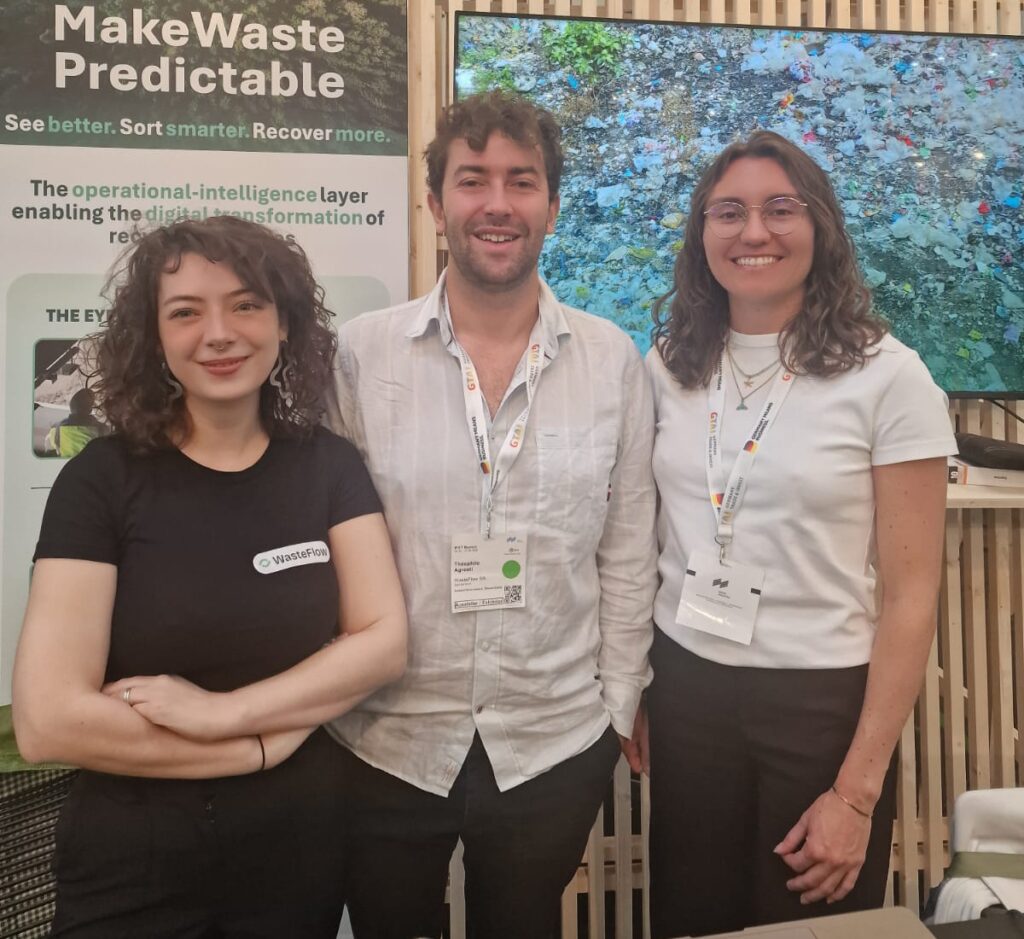
Artificial intelligence and robotics dominated this year’s IFAT Munich trade show. Exhibitors showcased battery detection systems, AI sorting robots and smart recycling plant technologies.
The event attracted around 142 000 visitors from 160 countries and featured more than 3 400 exhibitors, making it the largest edition in IFAT history. More than 50 start-ups also presented circular economy innovations focused on waste tracking, microplastics treatment and advanced sorting technologies.
‘Not the holy grail’
While AI was impossible to ignore across the exhibition halls, several industry experts urged recyclers to temper their enthusiasm with practicality. ‘AI is not a trend for us,’ says Nico Schmalbein, engineer at Steinert. ‘We have been working on it for over five years, long before it became a buzzword.’
According to Schmalbein, AI delivers the strongest results when combined with existing sorting systems rather than replacing them entirely. He points to aluminium sorting as an example, where AI can tackle silicon contamination without additional machinery.
‘You can decide to do everything with AI if you want to force it,’ he observes. ‘But it has to make sense and there has to be a clear benefit.’
Schmalbein sees growing pressure from customers who request AI-driven solutions because of market hype rather than operational needs. ‘Some clients ask for AI because they hear about it everywhere. ‘That does not always mean it is the right solution for their sorting line.’
He also stresses that metal recycling is particularly difficult for AI systems because scrap characteristics constantly change throughout the treatment process.
‘Plastic bottles can already be sorted relatively well,’ Schmalbein notes. ‘However, metals look different depending on the processing steps. As recyclers well know, many materials require a different approach. In short, AI is not the holy grail people think it is.’
Boosting safety
For start-ups at IFAT, battery safety and smarter sorting systems emerged as major business opportunities. ‘Battery safety is a huge trigger for recyclers to invest in smart sorting,’ says Amelie Finkbeiner, business development lead at Swiss start-up WasteFlow.
WasteFlow has developed a threefold sorting solution combining AI and sensor technology. As a result, the company achieves up to 97% sorting accuracy in some applications, including a paper sorting line at Paprec Group in France.
WasteFlow commercialised its technology last year and has installations in Switzerland, France and Spain. The company is also exploring robotics solutions for removing disposable vapes from waste streams. ‘Vapes are becoming a headache that hurts all of us,’ Finkbeiner says. ‘Something must be done.’
She believes smaller recyclers do not necessarily need large-scale AI investments. ‘Sometimes a smaller-scale AI system is enough,’ she explains. ‘That can cost as little as EUR 25 000. Unlike what many people think, AI does not always have to be expensive.’
Talking to the system
Slovakian company Vumz.Sk demonstrated a sensor-fusion sorting system combining RGB cameras, hyperspectral imaging and AI recognition software. Md Robert Prochazka says the system can replace two conventional sorting units while achieving between 80 and 85 picks per minute, depending on the material stream.
Packaging waste, especially plastic bottles, is the company’s strongest market. However, Vumz.Sk is preparing to launch a new language model allowing operators to communicate directly with sorting systems via speech or chat commands.
‘We want people to communicate with the machine using their own words instead of complicated programming commands,’ Prochazka explains. ‘By allowing straightforward communication that doesn’t rely on perfect grammar, I believe we will be able to boost sorting results even further.’
Don't hesitate to contact us to share your input and ideas. Subscribe to the magazine or (free) newsletter.
 Loading ...


