
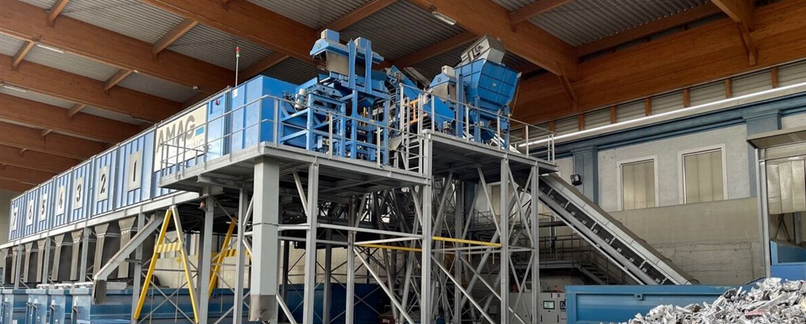
An emphasis on quality when sorting secondary raw materials will be the benchmark for Steinert’s presence at the Aluminium 2022 trade fair in Düsseldorf, Germany at the end of October.
‘Exporting materials of low-value and quality is a thing of the past,’ the company says. ‘Today, achieving the very highest purity levels is essential.’
Steinert introduced the first laser-induced breakdown spectroscopy (LIBS) sorting plant in Europe, enabling more secondary scrap to be recovered. Returning aluminium for recycling requires pure fractions which processors can only manufacture on a step-by-step basis. The recycling process initially involves the separation of ferrous and non-ferrous metals, both of which are possible with Steinert’s magnetic separation technology. X-ray transmission separates heavy metals from light metals to produce clean, defined aluminium mixtures. The company’s XSS T EVO 5.0 is praised by Stemin, the Italian recycling specialist that has relied on Steinert’s sorting machines for years. ‘We have opted to buy from Steinert because of its ongoing research and development in the field of metal recycling, the fact that the quality that its machines achieve, when sorting, is improving all the time and because its ever-more efficient sorting machines help us to produce the quality levels we need, says Olivo Foglieni, chair of Stemin’s holding company.
The Steinert LSS (line sorting system) enables the customer to separate multiple alloys in just one detection run by the LIBS sensor. LIBS is a technology used for elemental analysis. By default, the calibration methods stored in the measuring device analyse the concentrations of the alloy elements Cu, Fe, Mg, Mn, Si, Zn and Cr.
The sorting of alloys involves first separating the shredded material mixture in such a way that the material is fed past the laser, so that the laser pulses hit the surface of the material. This causes tiny particles of material to evaporate. The emitted energy spectrum is recorded and analysed simultaneously to detect the alloy itself and the individual alloy components of each individual object. Up to seven different materials are detected in the first part of the machine. Compressed air nozzles then shoot these materials into different bunkers in the second part of the machine, depending on their elemental composition.
Steinert will be at Stand 6F01, Hall 6, at the Aluminium 2022 trade fair from 27-29 October.
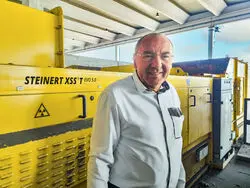
Chair of the FECS holding, to which Stemin belongs,
is once again turning to STEINERT XRT sorting technology.
Don't hesitate to contact us to share your input and ideas. Subscribe to the magazine or (free) newsletter.
 Loading ...


