
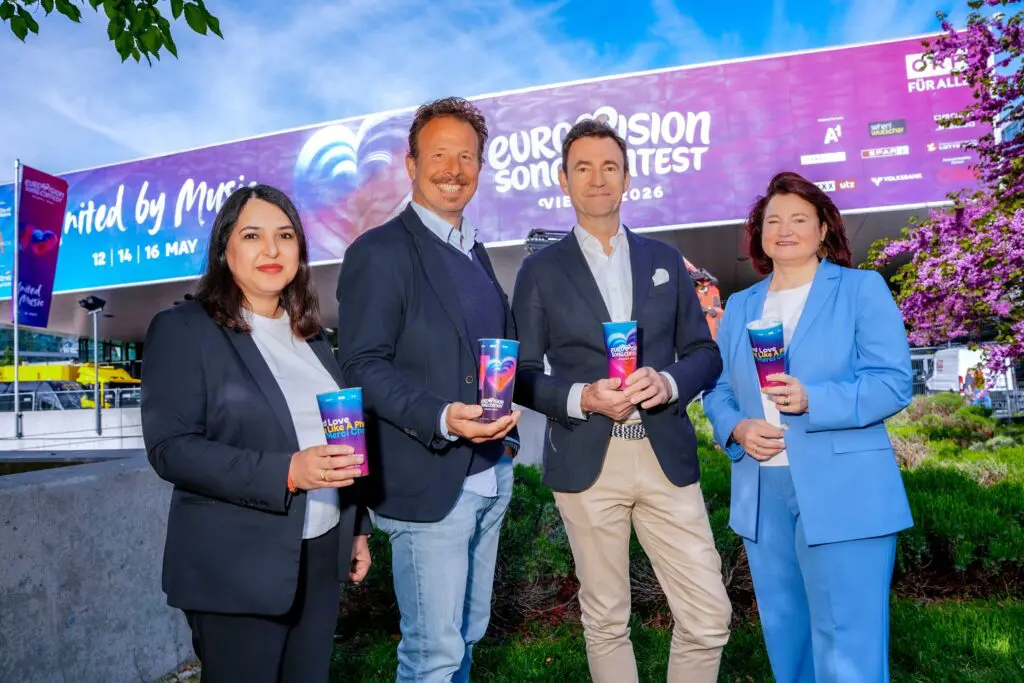
The Eurovision Song Contest is embracing a circular economy solution for plastics developed in Austria, where this year’s edition takes place.
Altstoff Recycling Austria (ARA) as the official event supplier, Borouge International (formerly Borealis), OMV and Greiner Packaging are ensuring 100 000 reusable cups made from 100% recycled plastic will be used during the main event and official side events in Vienna.
It is claimed the initiative will save some five tonnes of virgin raw materials and represents a fully closed-loop recycling solution: from waste collection and processing to cup production, every step of the value chain takes place in Austria.
Austrian recycling loop
The reusable cups are produced using plastic packaging waste collected through Austria’s nationwide yellow bag and yellow bin programme in both urban and rural areas. After collecting, the material is sorted and converted into high-quality flakes by ARA.
From waste to cups
These flakes are then processed at OMV’s ReOil plant, where they are transformed into synthetic crude oil. Borouge International converts this feedstock into food-grade plastic granules, which are used by Greiner Packaging to manufacture durable, fully recyclable reusable cups.
Best practice
‘Our reusable cups are a best-practice example of the Austrian circular economy in action,’ says ARA’s Harald Hauke. ‘Closed-loop recycling is key to achieving high sustainability standards,’ adds Shanila Baseley, vice president sales at Borouge.
Promoting awareness
The reusable cups play an active role in reducing waste during the Eurovision Song Contest by replacing single-use products. In addition, production benefits from short transport routes and resource-efficient processes, supporting the event’s status as a certified Green Event.
Second life
Each cup features a printed QR code linking to DigiDot, ARA’s digital recycling guide. Available in 25 languages, DigiDot helps visitors identify correct waste separation options and nearby collection points, both during the event and beyond.
After the Eurovision Song Contest competition, cups showing wear or damage will be recycled and returned to the loop, while reusable cups will be donated to social institutions – ensuring that the initiative delivers lasting environmental and social value.
Don't hesitate to contact us to share your input and ideas. Subscribe to the magazine or (free) newsletter.


