
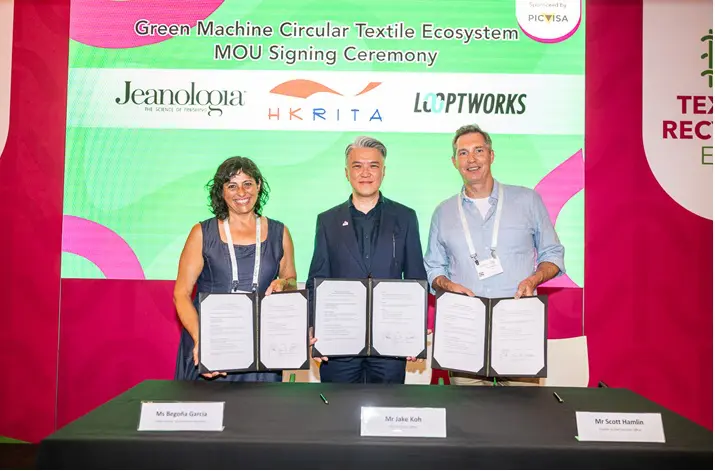
China’s HKrita, US recycler Looptworks and Spanish firm Jeanologia have signed a memorandum of understanding to develop an innovative textile recycling solution.
The international collaboration was announced at the textiles recycling expo in Brussels. It highlights growing commercial interest in technologies that can process blended textiles, including denim and mixed-fibre garments.
As brands, recyclers and manufacturers look for scalable circular solutions, technologies that can recover high-value fibres from post-consumer textiles are becoming increasingly important.
Complete treatment possible
At the centre of the project is The Green Machine, a polyester and cellulose recycling system that uses hydrothermal treatment and dissolution treatment to separate cotton-polyester blends. It is based in a pilot developed by R&D specialist HKrita.
By decomposing cotton into cellulose powder, polyester fibres are separated while maintaining quality, allowing fibre-to-fibre recycling.
The recycled cotton cellulosic powder can be used in re-spinning and agriculture, supporting a broader range of circular applications. The next phase aims to develop the Green Machine into a complete treatment process within an industrial set-up.
By separating the blended textiles, the system recovers PET fibre for re-spinning while converting cotton fibre into cellulosic powder for uses including composite fibre, water-retaining material for cotton farming and PFC-free durable water-repellent surface finish.
In this way, it supports the goal of end-to-end recycling, where post-consumer textiles are recovered as raw materials for the production cycle.
Varied waste stream
The Green Machine is attracting attention because it can handle difficult textile stream including denim and mixed textiles. Denim is a particular challenge for recyclers, which makes Jeanologia’s involvement especially relevant.
The process uses only heat, water and a small amount of environmentally safe chemicals, with a recovery rate of over 97% for polyester fibres within two hours. A major advantage is that it requires only 30% of the energy needed to produce virgin PET fibres.
‘Stronger together’
Based in Gresham, Oregon, Looptworks specialises in fibre-to-fibre textile recycling and works with blended textile streams that are often difficult to process through conventional recycling routes. Since its launch in 2009, the company claims more than 25 500 tonnes of material has been diverted from landfill.
Looptworks chief executive Scott Hamlin believes combining expertise across the value chain is essential for turning promising technologies into commercially viable recycling solutions
‘Pooling knowledge and experience is key if we want innovative solutions to deliver a real impact on the ground,’ he says. ‘This collaboration opens a new chapter for commercial textile recycling.’
Real world impact
The technology has already been applied in textile recycling and production. Monki, a fashion brand focused on sustainability, was the first brand to use textile materials from the Green Machine in its collection.
Aditionally, PT. Kahatex, a textile manufacturer in Indonesia, operates the first industrial-scale Green Machine. It has a processing capacity of 1.5 tonnes per day.
Iskotm, one of the world’s leading denim producers, has also acquired a licensing agreement for the Green Machine.
Feedstock opportunities
Despite rising interest, textile recycling still depends on a reliable supply of suitable feedstock. Post-consumer textiles, especially blended fabrics and denim, remain difficult to process using conventional recycling methods.
This creates an opportunity for collectors, sorters and waste management companies handling textile streams. By supplying feedstock to Green Machine facilities, operators may develop additional revenue streams while supporting circular economy objectives.
The partners say the Green Machine offers a commercially viable and complete blended-textile recycling solution, and the system is designed to be relatively easy to construct and operate.
Don't hesitate to contact us to share your input and ideas. Subscribe to the magazine or (free) newsletter.
 Loading ...


