
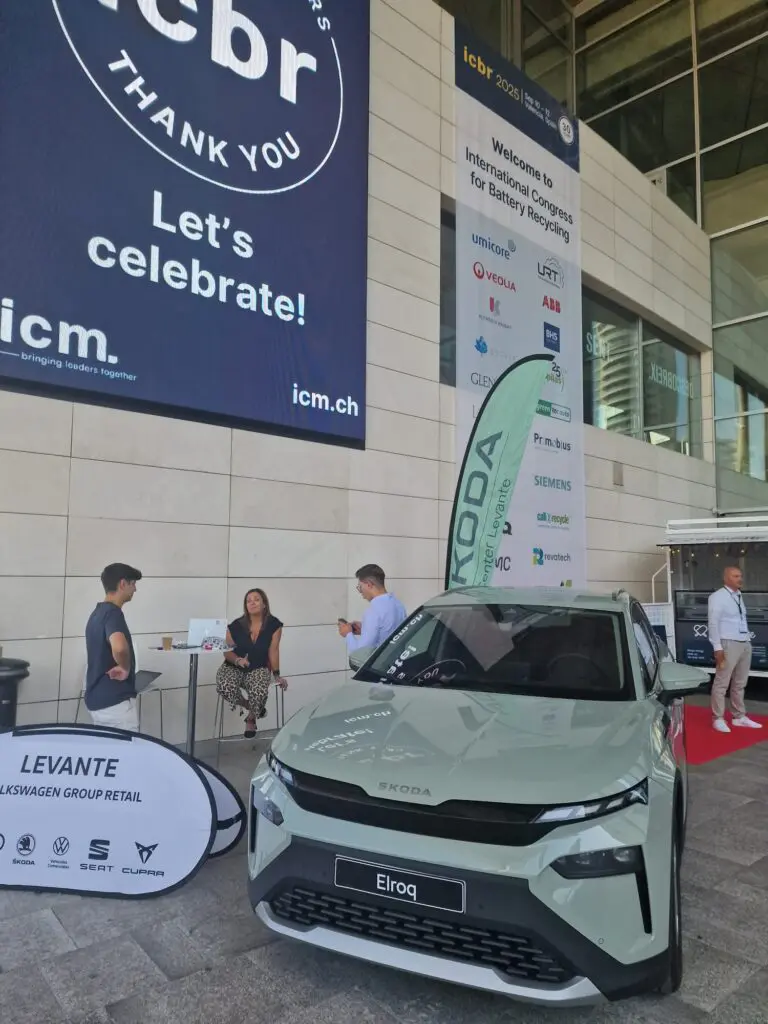
Europe’s battery industry faces a critical moment as electric-vehicle sales grow and recycling targets tighten. Speakers at the 30th International Congress for Battery Recycling (ICBR) in Valencia warned that policy and investment must catch up.
‘The road to hell is paved with good intentions, remember?’ observes Petr Kratochvil, general manager at Ecobat. ‘The EU List of Waste (ELW), which was somewhat revised in March to include lithium-based batteries, urgently needs further updating to take into account new chemistries and products.’
Hopelessly outdated
Kratochvil argued the EU waste list from 2000 was ‘hopelessly outdated’. It covers only five battery types while the new one will identify 55. Meanwhile, the Czech Republic, his home country, already recognises 44 categories. ‘The presence of hazardous substances in batteries doesn’t make it hazardous waste,’ he adds, underlining that the proposed update is ‘too narrow’.
‘They only looked at chemical substances and recycling efficiency reporting. This is a big mistake, an oversimplification of a complex waste stream.’
Transboundary shipment rules add to the burden. ‘There are many notifications these days because the transport goes through multiple countries. A recycle may receive up to ten notifications for one shipment before it reaches its final destination. That’s a little over the top, isn’t it?’
More chemistries, more complexity
Rana Plant of the European Commission’s DG Environment added a policy perspective and noted that ‘batteries are lasting longer these days’. Chemistry diversity remains a challenge and manufacturing scrap is growing fast. ‘Modern recyclers are dealing more and more with manufacturing waste, which is a lot purer than scrap,’ he said.
‘There are many varieties of battery chemistries and some are easier to treat than others. The EU’s standpoint is not to push tricky chemistries out of the market from the get-go. We want to enhance available technologies to treat them better.’
Battery leakage
Emilie Acke, lithium-ion specialist at Belgian collection group Bebat, highlighted the hidden losses of the scrap waste stream. ‘About half of Europe’s battery feedstock leakage is due to third-party collection, according to Deloitte data,’ she said. ‘Ultimately, it’s vital to be aware we measure collection data too early and overlook too much.’
Batteries often stay embedded in discarded electronics or are quietly hoarded. Exports to other EU states further blur the picture. ‘We don’t just need good data, we need a better system,’ Acke stressed. ‘Or we will not be able to meet future recycling or collection targets.’
For her, cooperation is key. ‘The success of our future depends not on single actions but on the unwavering commitment of everyone at the table.’
The right levers
Cédric Demonthy, vp battery solutions at Umicore, warned of a fragile supply chain. ‘Leakage of black mass to markets outside of Europe is a real problem. We need to incentivise Asian battery producers to recycle locally here. So how to address this issue? Especially bearing in mind trade rules are too slow and trade notifications take too much time.’
Demonthy insists the industry has to stop wasting time and instead focus on creating unity. He believes Europe must act now. ‘If you really want to be competitive, you have to take down borders in Europe first. The good news is that Europe has the technology and capacity. With the right levers and steady investments, we can build a resilient BEV supply chain.’
BASF Battery hub
BASF’s head of marketing and project management battery recycling Daniel Waldmann struck a similar note of cautious optimism, sparked by relatively strong sales in the EV segment. ‘There are many encouraging headlines about e-mobility and battery innovation, growing consumer awareness as well as R&D breakthrough and funding for start-ups.’
The chemical engineer lamented that Europe lacked refining capacity for black mass. ‘Building up the value chain remains challenging. As we all know, there is no magic button that delivers 100% pure black mass in one go. Recycling is a multi-step and arduous process.’
BASF opened a black-mass facility in Schwarzheide, Germany in June after a five-year delay. It can treat 15 000 tonnes of EV batteries a year, including production scrap. The process is flexible and includes a comprehensive off-gas treatment system.
‘We delayed our investments because market conditions were not favourable,’ Waldmann said. ‘So while we are confident this is the right path, there are some detours and some outstanding concerns.’ He is calling on the sector to join forces. ‘Let’s shape the future of e-mobility together.’
Don't hesitate to contact us to share your input and ideas. Subscribe to the magazine or (free) newsletter.
 Loading ...


