
Recycling happens everywhere. Even in the most remote places on Earth, where conditions do not exactly help recycling efforts and logistics can be a true nightmare. Places like Spitsbergen in northern Norway. Or Antarctica, where temperatures can drop below -80°C and winds reach 130 km/h.
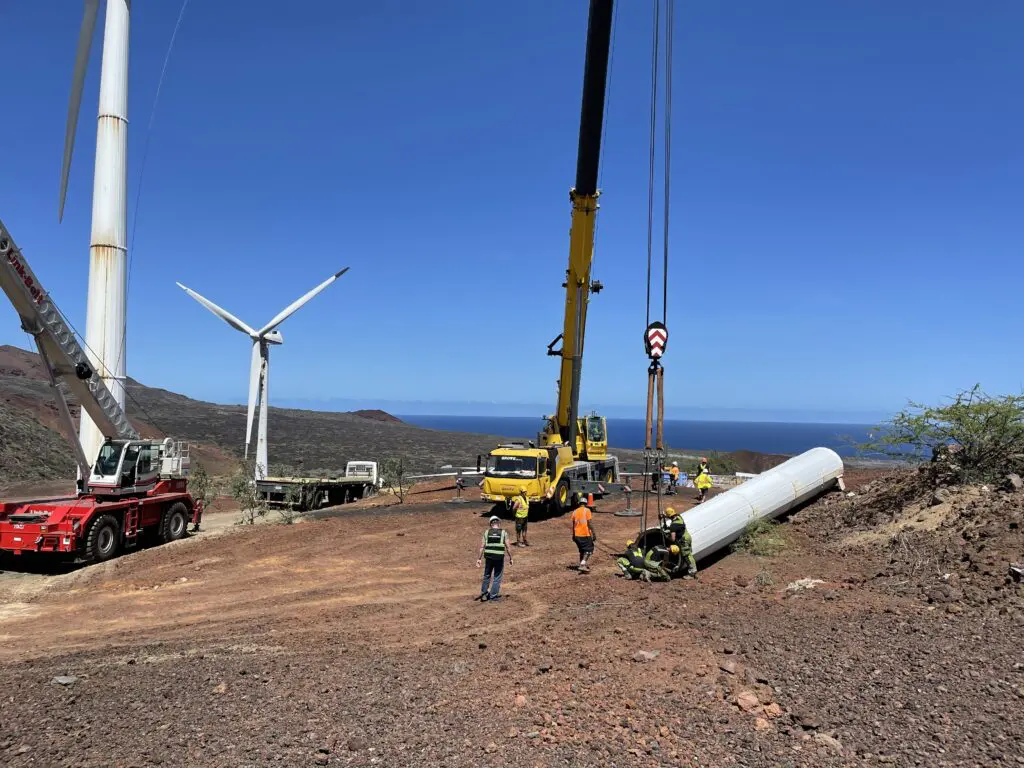
Ever heard of Ascension Island? It’s in the middle of the Atlantic Ocean, some 2 300 km from Brazil and 1 500 km from Angola. That’s quite remote. In March 2022, a Dutch team from wind turbine dismantling experts Business in Wind headed to the island on a special mission: to decommission and recycle six wind turbines.
Although the company is used to delivering in remote locations – it has worked in Albania, northern Scotland and Canada’s Yukon Territories among other places – this was far from an average job, and a logistical challenge for sure.
Quarantine
Weeks before the team arrived on the island, all the equipment, tools and generators needed to fix the job had been transported in by air. The team itself flew in on a military plane from Florida in the US. For the first eight days after arriving, members had to stay in quarantine due to local Covid regulations.
Eventually, they prepared the wind turbines for decommissioning using local cranes. The project was plagued by strong winds and constantly changing travel regulations. Finally, in cooperation with a local team, everything was carried out safely and the scrap was ready for transportation and further recycling. It had been a very challenging operation but the team was soon onto its next mission.
Minus 80 Celsius
On Antarctica, conditions can be extreme. It is a land of vast open spaces, fierce winds and extreme cold. Several nations operate research stations there, including the US Antarctic Program (USAP), for whom recycling is both a challenge and a necessity.
Under strict environmental protocols, all waste generated must be removed from the continent. This is no small task in one of the most remote and inhospitable regions on Earth, where temperatures can drop below -80°C and winds reach 130 km/h.
At peak times, more than 1 000 USAP personnel are stationed across the region. Managed by the National Science Foundation, USAP conducts vital research on Antarctica’s ecosystems and their connection to global processes such as climate change.
The region is also a platform for studying Earth’s upper atmosphere and outer space. With this scientific activity comes significant waste. USAP generates more than 1 300 tonnes…
Read the full article in our latest issue >>
Don't hesitate to contact us to share your input and ideas. Subscribe to the magazine or (free) newsletter.
 Loading ...


