

Artificial Intelligence (AI) is revolutionizing the recycling industry, optimizing sorting processes, and increasing recycling rates. Deep learning is propelling AI to new heights today.
A fully circular economy relies on consistently high-quality recovered materials, which is not yet possible with today’s processes, and many recovered materials are still downcycled. To avoid this, sorting must become more granular. And this is where AI is a game-changer.
There is a common misconception that AI is a recent phenomenon. Infact, AI has been integral to our industry for decades. It refers to any technique that enables computers to ‘mimic’ human intelligence using logic, if-then rules and machine learning.
Machine learning has been a standard feature of sorting systems for decades. Even the early machines, dating back some 30 years, employed basic AI principles as they were capable of making decisions about which materials to eject and reject.
Deep learning is propelling AI to new heights today
Deep learning is the cutting-edge advancement that is propelling AI to new heights today. Deep learning is a specialized approach within machine learning that focuses on a specific type of algorithm called artificial neural networks.
Thousands to millions of images are fed into the networks as training material until the system learns to distinguish certain visual characteristics of material types such as specific bottle caps or packaging shapes. It can apply this knowledge to new images from the sorting system’s sensors.
The many advantages of deep learning
Deep learning makes it possible to solve some of the most complex sorting tasks which are currently impossible with conventional optical sorting equipment. Here is an overview of the many advantages of deep learning:
- Improved sorting: By combining existing optical sorting systems, which are based e.g on near infrared (NIR)
and visual information sensors (VIS), with deep learning technologies, we can achieve the highest sorting granularity currently available. This enables the sorting by material type and color and now, thanks to deep learning, also by shape, size, dimensions or other details. - Creation of new material streams: Deep learning solves previously impossible tasks, such as the sorting of food vs. non-food plastics packaging. Operators can not only enhance sorting granularity but create new material streams and markets with higher value outputs.
- Advanced plant automation: Deep learning can automate sorting tasks that previously had to be carried out manually, enabling our industry to process larger quantities of recyclable materials quickly and efficiently.
- Flexibility: Instead of replacing hardware components or even machines, modern deep learning technologies can be retrofitted with software updates as soon as they have been trained by AI experts. This allows operators to respond more quickly to market needs.
The industry’s first Deep Learning system GAINnext™

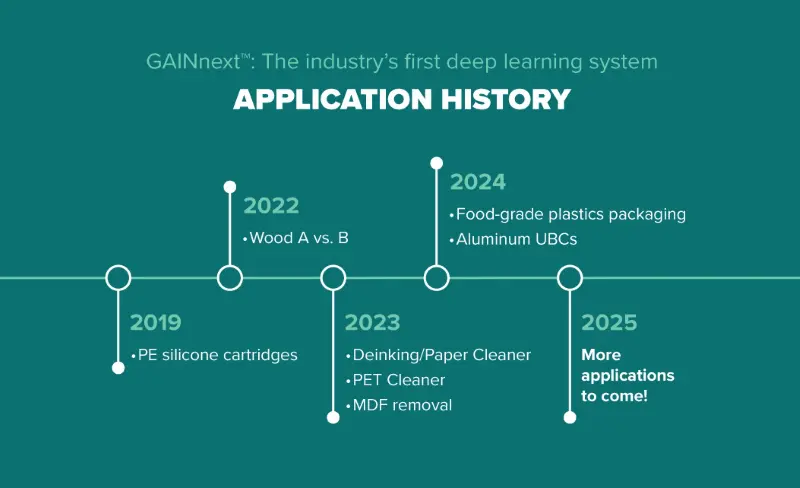
TOMRA’s GAINnext™ system, introduced in 2019, marked a significant milestone in the recycling industry. Initially designed for a single sorting task, GAINnext™ has now evolved into a comprehensive ecosystem of applications.
This groundbreaking technology enhances material streams by efficiently removing hard-to-classify items such as colored paper, envelopes, and receipts in paper sorting, or opaque white bottles, textiles, multilayer films, and full sleeves from PET streams. In wood sorting, GAINnext™ separates natural wood from processed wood, including MDF.
The system’s capabilities peaked in 2024 with the first industry-wide solution for sorting food and non-food PET, PP, and HDPE packaging, revolutionizing the market and creating new business opportunities. TOMRA recently introduced GAINnext™ in metal sorting, enhancing the quality of recycled wrought aluminum scrap.
AI: A catalyst for green transformation
With stricter regulations and growing consumer demands, our industry is at a turning point. Deep Learning has the potential to significantly advance the circular economy and create new markets for higher-value products, and it’s happening at the right time.
Having installed far more than 100 of these intelligent systems around the globe and with numerous deep learning applications in the pipeline, TOMRA’s deep learning journey is just beginning and promises further progress for the market.
Learn more about Deep Learning and the industry’s leading solution GAINnext™.
Don't hesitate to contact us to share your input and ideas. Subscribe to the magazine or (free) newsletter.
 Loading ...


