
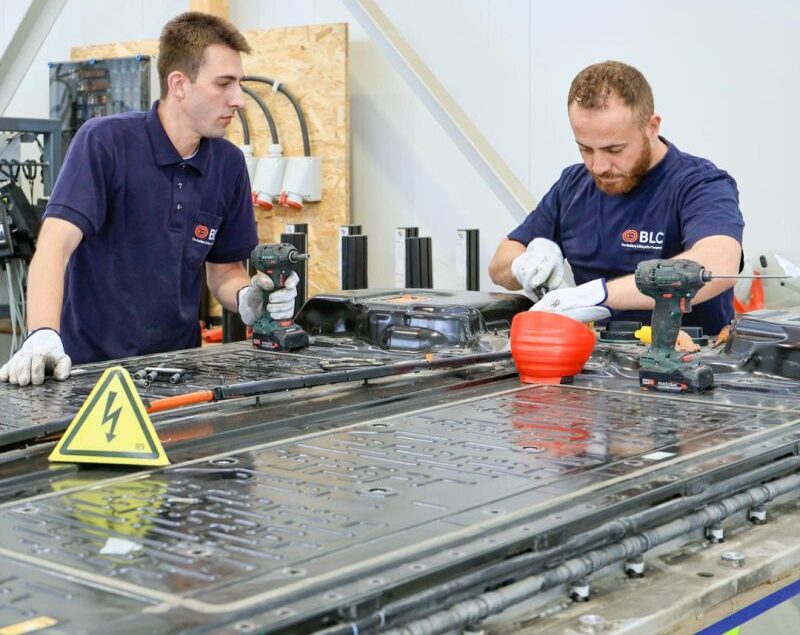
‘The battery industry is exciting, challenging and full of potential,’ observes Lukas Brandl, managing director of Battery Lifecycle Company (BLC). He believes having the right technology and strategy in place will allow the recycler player to significantly ramp up operations in the next few years.
‘Recently, all market players have experienced just how volatile the market can be. They have also seen the gap between forecasts and reality,’ Brandl pointed out at the International Congress for Battery Recycling (ICBR) in Berlin last week. The entrepreneur was eager to host a plant tour of his facility, which aims to become one of Germany’s main battery recycling hubs.
The joint venture between TSR Group, part of the Remondis Group, and Rhenus Automotive launched around three years ago. It now operates a pilot plant in Rheda-Wiedenbrück and a larger facility in Magdeburg, where he welcomed many ICBR delegates.
The Magdeburg plant has capacity to treat 15 000 tonnes of batteries annually. BLC handles several battery types, with electric vehicle and energy storage batteries making up most volumes.
Safe and efficient discharging
Most batteries currently arrive directly from producers. However, Brandl expects the post-consumer share to increase as end-of-life volumes mature. He is ready to take ‘bold action’. BLC aims to at least double its capacity to 30 000 tonnes per year within two years. The expansion will depend partly on securing the necessary permits.
Meanwhile, greater automation will help the company increase throughput and flexibility. BLC is working with German recycling technology provider No Canary, which develops lithium-ion battery recycling equipment and complete recycling-line solutions.
‘We have been using two of No Canary’s mobile zero-voltage-discharge units since the beginning of 2025,’ Brandl says. ‘Results have been very promising. The latest unit has been active for two weeks now. We can successfully deactivate around one tonne of lithium-ion batteries an hour.’
The units recover electrical energy during discharge. No Canary specifies energy-recovery efficiency of up to 95% for its discharge technology, with recovered energy returned to the facility network.
Flexible battery processing
BLC currently employs 30 people at the Magdeburg facility across three shifts. Its operations combine manual and semi-manual processes for discharging, repairing and dismantling batteries.
The company also commissioned a semi-automated unit for module deactivation two years ago. It is now setting up a new flexible No Canary unit that can discharge products ranging from individual modules to complete battery packs.
‘The set-up of our production operations is extremely flexible,’ Brandl explains. ‘It allows us to adapt our processes to various products and link together different steps.’
This flexibility is becoming increasingly important as battery designs evolve. BLC dismantles, deactivates, sorts and packs batteries before preparing them for recycling by industry partners.
The company also handles batteries that could potentially have a second life. ‘We are not just processing waste but products as well,’ Brandl says. ‘We enable our partners to increase the value of their batteries by making sure they are given a second life.’
Design for recycling
Despite the growing battery production base, returns of end-of-life batteries remain relatively low. Brandl says ongoing battery innovation creates both opportunities and challenges for recyclers. Cell-to-pack designs and different gluing technologies, for example, can complicate dismantling and sorting.
‘We really would like producers to talk to us more when they develop their products,’ he says. ‘They should actively take design for recycling, or at least design for repair, into account.’
At the same time, Brandl says these challenges push BLC to develop new solutions as battery technology continues to evolve.
ICBR ‘going strong’
The 31st edition of the ICBR took place in Berlin from 9-11 September, attracting a global audience of around 550 delegates. The ICBR expo welcomed 55 exhibitors, including three start-ups. Participants came from more than 20 countries.
Event organiser ICM has announced that the upcoming ICBR will take in Basel, Switzerland, from 8-10 September 2027. ICM underlines that interest in the conference continues to grow following its launch over three decades ago.
Do you want to know more about this event? Stay tuned for the ICBR 2026 report, which will be published in our November/December issue.
Don't hesitate to contact us to share your input and ideas. Subscribe to the magazine or (free) newsletter.


