
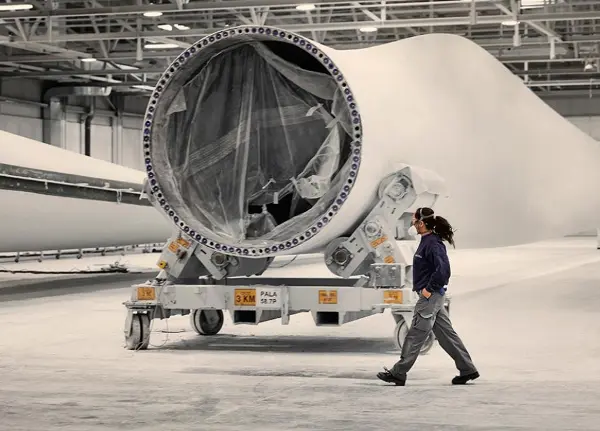
Europe will have around 350 000 tonnes of end-of-life wind turbine blades by 2030. Partners in an R&D project DecomBlades are calling for widespread industry support to ensure this modern waste stream can be recycled.
Globally, over 2.5 million tonnes of composite materials are in use in wind turbines. Cost-effective processing methods for carbon fibre are essential to unlock this material source.
DecomBlades, a three-year project with 10 industry partners and EUR 20 million in funding from the Danish government and private investors, has concluded with promising results.
Industrial-scale pyrolysis
A key achievement of DecomBlades is the establishment of a large-scale pyrolysis plant, operated by Makeen Energy. This facility separates glass fibre from wind turbine blades, recovering premium quality material for new blades.
Makeen Energy’s team has developed a continuous process that separates the material into gas, oil and solids. The blades are finely cut and shredded before being processed in the reactor.
The resulting solids, comprising glass fibre coated with black carbon, are processed to produce clean fibre. This is milled into a fine powder with impurities such as metal removed. The powder can be remelted into new glass fibre, suitable for the next generation of blades.
Irene Bach Velling Villadsen, project manager at Makeen Energy, emphasises that the recycling process does not degrade the fibre quality. ‘At first attempt, we have succeeded in recovering and processing glass fibre suitable for inclusion in the raw material mix on a par with virgin material,’ she says.
‘We have achieved this important milestone at an industrial level. The process has real commercial prospects. It’s incredibly exciting to have reached this point.’
Proof and demand
This is promising news for both the recycling industry and the energy sector, according to John Korsgaard, senior director at LM Wind Power and chairman of the DecomBlades consortium.
‘Our project has demonstrated that wind turbine blades can be reused for new blade production. But that alone doesn’t create a business basis in the sub-supplier chain.’
Korsgaard insists that producers must demand recycled products to establish a robust value chain. He believes a material passport can help industry players sort recyclables into different fractions, strengthening the sub-supplier chain.
Don't hesitate to contact us to share your input and ideas. Subscribe to the magazine or (free) newsletter.
 Loading ...


