

‘I have to tell you something,’ my 13-year-old niece Isa whispered to me during my father’s birthday party. Immediately, I braced myself for a story about heartbreak or school drama. Instead, she excitedly revealed a purple handheld device with a label that read ‘sour cherry’.
No-one in my family was thrilled. Still, as every parent, aunt or uncle knows, forbidden things often become irresistible. I tried my best to hide my concern and annoyance. That only heightens rebellious behaviour, right?
One holiday, I remember my mum sitting me and my sister down and handing us a cigarette. We must have been around 15 and 16 years old (trends have a way of finding an ever-younger audience). I picked it up hesitantly. ‘You will probably see these at school. Some kids will offer them to you. They’re not all that great. But I’d rather you find out with me, rather than behind my back,’ she told us. ‘Go on, let’s give it a try.’
I took a couple of puffs and coughed. My sister was equally unimpressed. We put out the cigarettes and returned to sipping our ice teas. I never understood the hype, even then.
Disposable headache
Perhaps Isa will lose interest once she realises how quickly vaping drains her allowance. Disposable models start at around EUR 5, while reusable versions range from EUR 20-60. Yet cost is only part of the problem. The real concern begins once these colourful gadgets reach the waste stream.
Globally, more than 100 million people now vape, including an estimated 15 million teenagers. The global e-cigarette market is projected to soar from roughly EUR 33 billion in 2025 to more than EUR 180 billion by 2032.
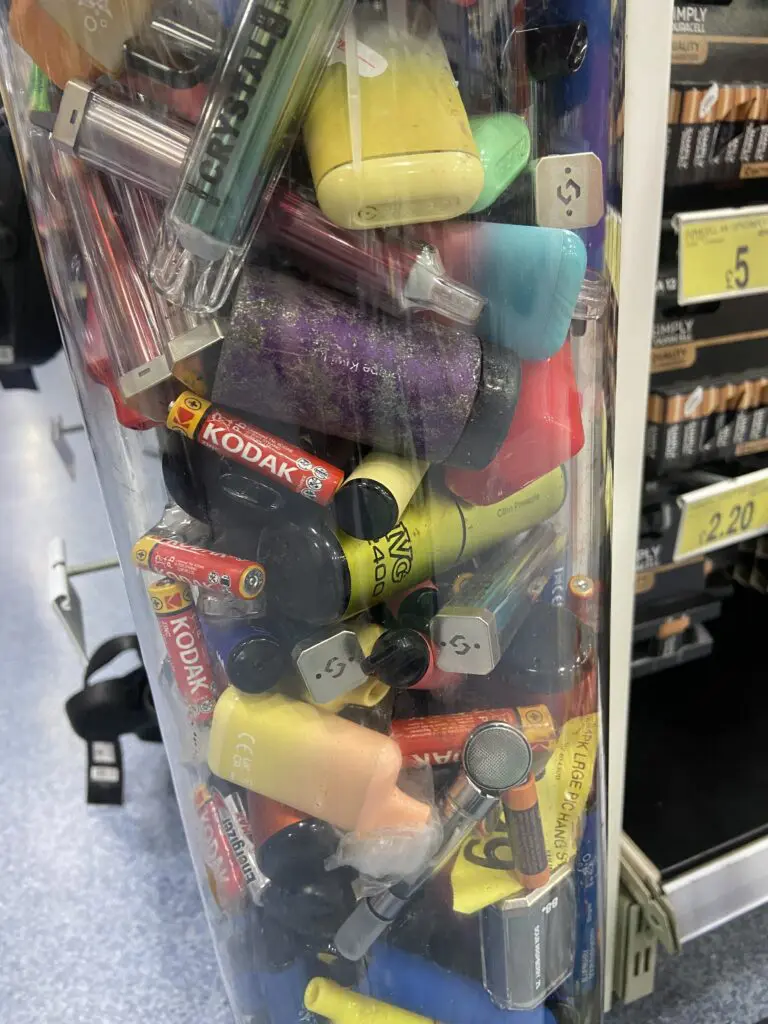
The devices themselves may look harmless. However, recyclers know better, describing the products as a ‘headache’ or ‘nuisance’. They come in various shapes and sizes.
The material complexity is striking. Sealed tightly inside a typical aluminium casing, vapes also contain copper wiring, cobalt, nickel and lithium batteries, alongside plastics such as polycarbonate and nylon. Trace elements including lead, mercury and chromium have also been identified in certain components.
Because around 80% of the product is plastic, many consumers recklessly throw them into plastic recycling bins or general household waste.


Fires are inevitable
Unfortunately, the consequences are profound. In the UK alone, an estimated 6.3 million disposable vapes are discarded every week. Over the past four years, vapers have thrown away roughly 1.18 billion units.
The waste management sector is paying the price. Firstly, workers must manually remove vapes from conveyor belts before processing. At some facilities, crews extract more than 150 devices every day and dismantle them by hand with hammers. This adds labour costs and slows down overall operations.
Secondly, safety is a risk that cannot be overstated. Last year, waste company SUEZ recorded 670 fires across its UK sites. Of those, 368 were directly linked to batteries or vapes, while another 176 were suspected to involve them. For Biffa, there were no fewer than 1 200 incidents.
Indeed, I recall a major incident at Herne Hill, south London in 2024 that required 15 fire engines and nearly 100 firefighters to get the blaze under control. It burned for four days.
The financial impact is enormous. Adam Read of SUEZ estimates embedded batteries cost the UK economy around EUR 1.1 billion annually in clean-up costs and fire damage. He believes offering a small reward, say EUR 2, could ‘dramatically reduce’ the number ending up in general waste. That could cut the fire risk by 70-90%.
Collection or chaos?
Governments are responding with increasing urgency. Since June 2025, 40 countries including the UK, France, Australia and New Zealand have banned disposable vapes. Retailers must also offer take-back services. Across the UK, there are more than 10 500 battery collection bins.
Even so, awareness is still worryingly low. Research by Material Focus found that 47% of vapers did not know vapes could be recycled. A more encouraging fact is that 57% of respondents say they are more likely to buy vapes from a store if they provide recycling drop-off points.
Some manufacturers now offer mail-in collection schemes, while others collaborate with municipalities and recycling groups such as Wecycle to install public drop-off points in supermarkets and pharmacies.
Building on engagement
At the IFAT expo in Munich, I met several recycling players (tech providers, recyclers and start-ups) all hoping to end the ‘toxic legacy’ of vapes. They see it as a logical add-on to battery recycling and insist there must be a better way of handling them. Having innovative recycling systems, however, is only one part of the answer.
Widespread understanding from society and legislators is key. To that end, the suggestion is that vape awareness efforts piggyback recycling campaigns targeting e-bike batteries and consumer electronics.
‘It would be a waste to start from scratch every single time,’ asserts Franziska Kühl, coo of URT Umwelt. The German firm creates solutions for fridges and consumer electronics to batteries. ‘Batteries are “hot” right now across many markets. Let’s use that to get people to pay attention so they will properly discard of vapes, too.’
Let’s hope our best concentrated efforts will stop this ‘vapeocalypse’ in its tracks.
Don't hesitate to contact us to share your input and ideas. Subscribe to the magazine or (free) newsletter.


