

Page 37 from: December 2013
37December 2013
Ferrous
December. Having threatened to break
through the US$ 140 barrier earlier in
the fourth quarter, the price of 63.5%
Fe fines took up residence just below
this threshold, achieving a peak of
US$ 139 per tonne cfr China around
the middle of November before edging
back to around US$ 136 at the time of
writing.
In October, Chinese imports of iron ore
exceeded the year-to-date monthly
average in reaching 67.83 million
tonnes – equivalent to a drop of 9%
when compared to September but a
leap of more than 20% over October
last year. According to Chinese customs
data, Australia was the leading sup-
plier on 35.95 million tonnes, followed
by Brazil on 12.73 million tonnes.
Across the first 10 months of 2013,
China imported a total of 668.35 mil-
lion tonnes of iron ore, or some 10%
more than in January-October last year.
Steel
In the first 10 months of 2013, China
produced almost exactly 50 million
tonnes more crude steel than in the
corresponding period of 2012. To put
that into context, the increase in Chi-
nese output was equivalent to this
year’s total January-October steel pro-
duction of Turkey and the Middle East
combined.
In October, China churned out 65.081
million tonnes of steel (+9.2% year on
year) for a 10-month cumulative total
some 8.3% higher than that for Janu-
ary-October 2012 at 652.48 million
tonnes, according to the latest statisti-
cal summary from the World Steel
Association (WSA).
According to more recent estimates
released by the China Iron & Steel Asso-
ciation, the country’s crude steel produc-
tion climbed more than 2% to a daily
average of 2.144 million tonnes in the
first 10 days of November when com-
pared with the final third of October.
However, a subsequent backward step
in domestic steel prices saw average
daily output fall to 2.132 million tonnes
in the middle portion of November.
The WSA figures reveal that Asia’s other
leading producers also made more
crude steel in October this year than in
the same month in 2012: Japan 9.518
million tonnes (+7.7%); India 6.76 mil-
lion tonnes (+1.6%); and South Korea
5.918 million tonnes (+5.2%). Despite
this increase, the 10-month running
total for South Korea was still 5.4%
lower than in 2012 at 54.585 million
tonnes whereas the same comparison
for Japan and India revealed year-on-
year growth of, respectively, 2% to
91.953 million tonnes and 2.8% to
66.387 million tonnes.
EU progress
The EU-27 continued its recent progress
with a crude steel output of 14.699 mil-
lion tonnes in October – equivalent to
an increase of 4% over the correspond-
ing month last year. Making the same
comparison, US production jumped
8.7% to 7.39 million tonnes while size-
able gains were also made by Turkey
(+6.9% to 3.078 million tonnes), the
Middle East (+13.8% to 2.278 million
tonnes) and Africa (+12.3% to 1.395
million tonnes). Ukraine saw growth of
1.2% to 2.628 million tonnes whereas
declines were posted by Russia (-1.5%
to 5.667 million tonnes), Brazil (-2.8%
to 3.02 million tonnes) and Oceania
(-4.5% to 481 000 tonnes), according
to the WSA figures.
Comparing January-October 2013 with
the corresponding period last year,
EU-27 crude steel production was still
lagging 3.4% behind at 138.406 mil-
lion tonnes while US output was 2.8%
lower at 72.687 million tonnes. Year-
on-year declines were also recorded by
Turkey (-3.8%), Russia (-2.7%), Brazil
(-1.1%) and Oceania (-3.6%). By con-
trast, production in the Middle East and
Africa climbed, respectively, 7% to
21.5 million tonnes and 4.9% to
13.274 million tonnes.
The 65 nations reporting to the WSA
produced 134.262 million tonnes of
crude steel in October this year for an
increase of 6.6% over the 125.919
million tonnes of 12 months earlier.
Across the January-October period,
output was 3.2% higher at 1.321 bil-
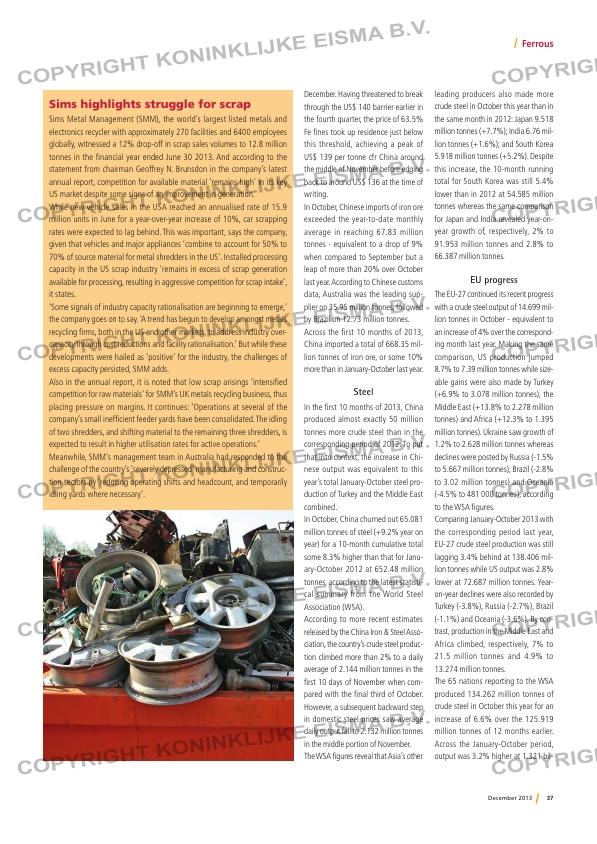
Sims highlights struggle for scrap
Sims Metal Management (SMM), the world’s largest listed metals and
electronics recycler with approximately 270 facilities and 6400 employees
globally, witnessed a 12% drop-off in scrap sales volumes to 12.8 million
tonnes in the financial year ended June 30 2013. And according to the
statement from chairman Geoffrey N. Brunsdon in the company’s latest
annual report, competition for available material ‘remains high’ in its key
US market despite some signs of an improvement in generation.
While new vehicle sales in the USA reached an annualised rate of 15.9
million units in June for a year-over-year increase of 10%, car scrapping
rates were expected to lag behind. This was important, says the company,
given that vehicles and major appliances ‘combine to account for 50% to
70% of source material for metal shredders in the US’. Installed processing
capacity in the US scrap industry ‘remains in excess of scrap generation
available for processing, resulting in aggressive competition for scrap intake’,
it states.
‘Some signals of industry capacity rationalisation are beginning to emerge,’
the company goes on to say. ‘A trend has begun to develop amongst metals
recycling firms, both in the US and other markets, to address industry over-
capacity through cost reductions and facility rationalisation.’ But while these
developments were hailed as ‘positive’ for the industry, the challenges of
excess capacity persisted, SMM adds.
Also in the annual report, it is noted that low scrap arisings ‘intensified
competition for raw materials’ for SMM’s UK metals recycling business, thus
placing pressure on margins. It continues: ‘Operations at several of the
company’s small inefficient feeder yards have been consolidated. The idling
of two shredders, and shifting material to the remaining three shredders, is
expected to result in higher utilisation rates for active operations.’
Meanwhile, SMM’s management team in Australia had responded to the
challenge of the country’s ‘severely depressed’ manufacturing and construc-
tion sectors by ‘reducing operating shifts and headcount, and temporarily
idling yards where necessary’.
RI-10-Analysis Ferrous.indd 37 05-12-13 14:50


