
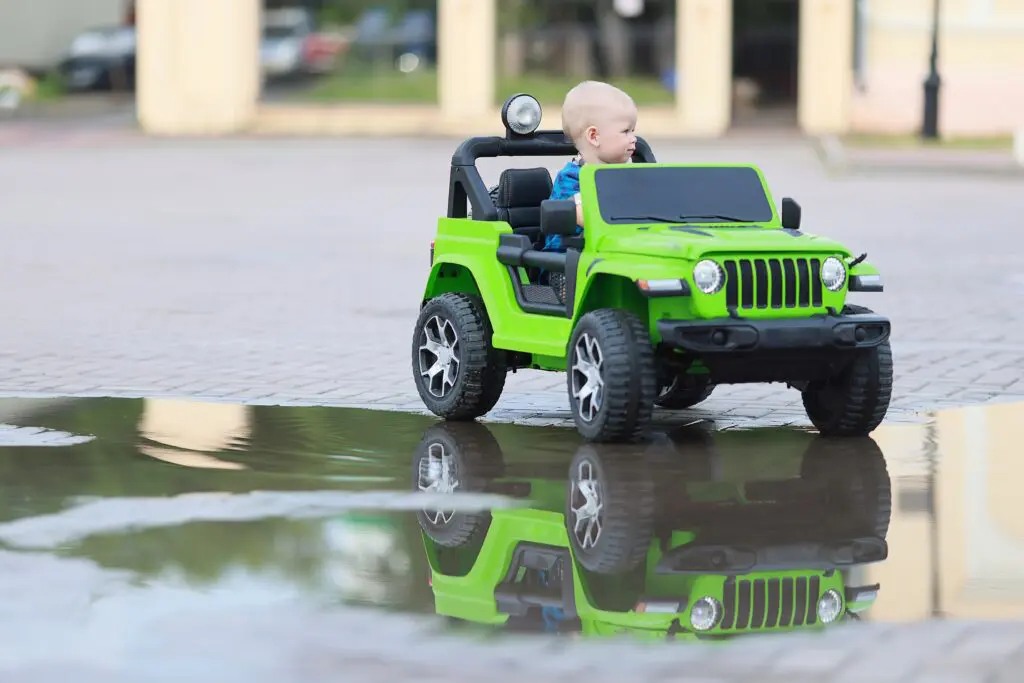
While the EV debate usually revolves around passenger cars, energy grids and gigafactories, a much smaller – and louder – electric vehicle is quietly carving out its own market. Children’s cars.
If you’ve been to a shopping mall lately, you’ve probably seen them. Mini SUVs circling tiled floors with flashing lights and built-in radios. Parents hovering nearby with a remote control, steering from a safe distance. Last summer in Valencia, my son Robin tried one for the first time. He drove and I navigated for a full hour. Three speeds. Reverse gear. A horn he used generously.
Tiny wheels, big market
It felt like a novelty. The data tells a different story. According to recent market research, the global electric children’s car market was valued at around EUR 2.2 billion in 2025. Analysts expect it to grow to EUR 4.2 billion by 2035.
Bear in mind licensed real miniature cars are already out there:
- Audi
- BMW
- Mercedes-Benz
- Porsche
- Lamborghini
- Bentley
- Ford (Mustang, F-150)
- Jeep
- Land Rover
- Chevrolet (Corvette)
For such a young and niche segment, those figures are striking. This is no longer just a toy category. It is a battery-powered mobility market in its own right. And where batteries go, recycling eventually follows.
Most children’s electric vehicles today still run on sealed lead-acid batteries. They are cheap, robust and familiar to recyclers. However, the shift has already started. Higher-end models and rental fleets increasingly use lithium-ion batteries, driven by longer run times, faster charging and lower maintenance. The logic mirrors what we have seen in adult EVs, just scaled down.
Such vehicles are used hard. Rental units operate all day. Batteries are charged frequently, sometimes carelessly. Repairs are basic. Replacement is often faster than refurbishment. When performance drops, batteries are swapped out, with little thought given to what happens next.
In the grey zone
There is a strong sense of déjà vu here. For years, legislation around electric light vehicles such as e-bikes and e-mopeds lagged behind. Policymakers focused on passenger EVs first, followed by e-buses and e-trucks. Smaller formats were treated as an afterthought. Rules on batteries, safety and end-of-life management arrived late, once volumes had already surged.
Children’s electric vehicles now sit in a similar grey zone. Too small (and perhaps playful) to attract serious regulatory attention, yet too widespread to ignore. As volumes grow, so will discarded small-format batteries, chargers, motors and electronics.
That brings us to the most practical question of all: who takes responsibility at end of life? Is it the toy brand that sells the vehicle, often with outsourced battery production? Is it the battery manufacturer, several steps removed from the consumer? Or does responsibility fall to local recyclers, who may not even be aware these batteries exist in such numbers?
Perhaps the answer is cooperation. A shared take-back model between toy brands, battery suppliers and recyclers. Or a dedicated collection scheme, supported by government, similar to existing frameworks for electronics and cars. Financial incentives, such as a recycling fee, may be needed.
Forgotten toys
The UK already offers a telling snapshot. An estimated 7.5 million battery powered toys are currently sitting unused in homes. At the same time, there are around 30 000 collection points nationwide that accept such products. Some 70% of these toys are said to still be in working order. They could be donated to other families, repaired for reuse, or recycled efficiently at local level. Forgotten toys are slowly becoming waste by default.
Rental fleets add another layer. Operators in shopping centres and holiday parks control large numbers of vehicles and batteries. They may be best placed to trial refurbishment, standardised battery packs or closed-loop recycling. But only if the framework exists.
One thing is clear: the popularity of children’s EVs is growing. They offer another reminder that recycling conversations should start early – even when the driver still needs a remote control.
Don't hesitate to contact us to share your input and ideas. Subscribe to the magazine or (free) newsletter.
 Loading ...


