
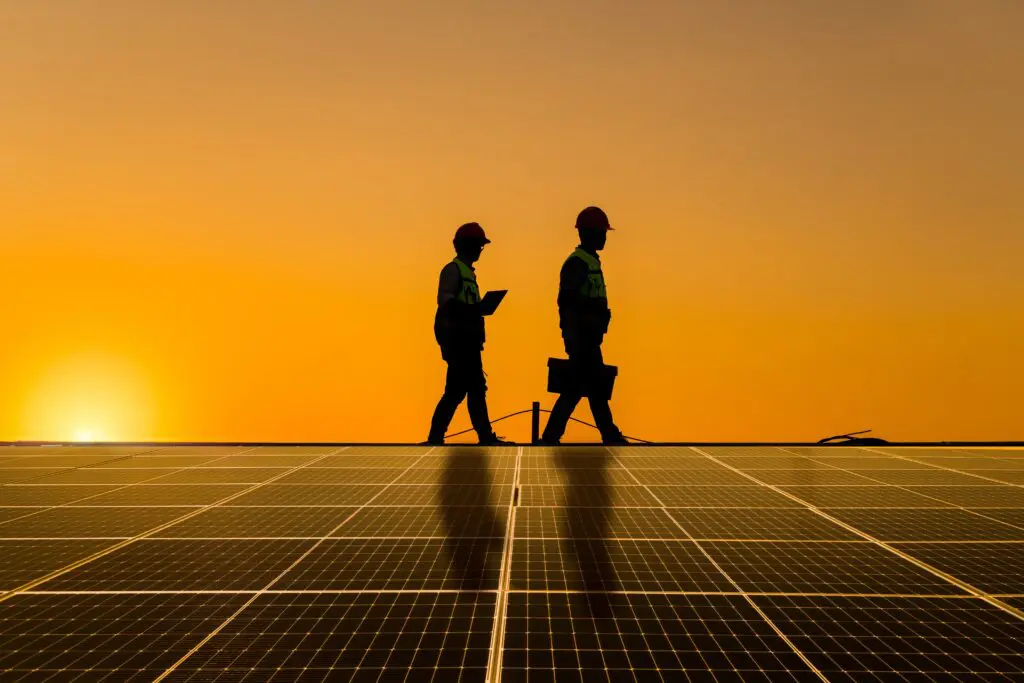
Up to 158 million people worldwide are employed in the circular economy and renewable energy sectors, according to a new report.
The report has been produced by Circle Economy in collaboration with the International Labour Organization (ILO) and the World Bank Group and sets out steps to boosting this total.
The analysis finds that an estimated 121 to 142 million people are employed in the circular economy worldwide, representing 5-5.8% of total global employment, excluding agriculture. Most of this employment is in fully circular sectors such as repair, recycling, second-hand trade, waste management and urban transit (121 million people or 5% of global employment).
Another 21 million (0.8%) are found in partially circular sectors, such as mining manufacturing and construction. Separate estimates by the ILO and the International Renewable Energy Agency indicate that 16.2 million people are employed in the renewable energy sector.
Combined, employment in the circular economy and renewable energy sectors may reach as many as 157.7 million. Women account for 26%, with the highest shares in upper-middle income countries.
Scarce data
The report authors point out that current evidence is largely focused on industrialised countries, while data on workers in the informal economy in developing countries is especially scarce. They say this hinders the development of inclusive policies capable of unlocking the circular economy’s full potential for decent work and sustainable development.
‘Realising the potential for a just and job-rich transition requires a shift from informal, low-skilled and low-paid activities towards productive, formal and decent work. For billions of people living and working in poverty, circularity is a necessity rather than a choice.
‘More research is needed to fully understand how the twin transitions to circularity and formality can generate full, productive, and freely chosen employment for all women and men alike.
Repair and maintenance activities (including those in manufacturing) account for nearly half (46%) of total circular economy employment, providing work for at least 65.2 million people. Waste-related activities employ 11 million workers (8%), while the manufacturing sector employs 34.8 million people (24.6%), which includes repair and maintenance jobs within the sector. The construction sector employs 7.7 million people (5.4%).
Next steps
Conclusions from the report include:
- governments should promote circularity in high-potential sectors beyond fully circular industries, leveraging public procurement and investment to create employment rich opportunities
- greater support for sustainable enterprises and community-based initiatives
- wider social protection, improved occupational safety and health and fundamental labour rights are all essential
- effective policymaking depends on robust data ecosystems at local, national and international levels
The authors conclude: ‘By combining strong evidence, social dialogue and inclusive policymaking, countries can harness the circular economy to advance environmental goals while generating decent work, reducing inequalities and strengthening resilience in the face of economic and ecological transitions.’
Don't hesitate to contact us to share your input and ideas. Subscribe to the magazine or (free) newsletter.
 Loading ...


