
Page 63 from: Recycling International November/December 2025
BATTERIES
63recyclinginternational.com | November/December | 2025
encourage the growth of domestic
recycling – meaning more cathode
active material (CAM) and precursor
cathode active material (p-CAM)
capacity.
There are concerns over the EU’s
updated List of Waste marking LFP
black mass as hazardous waste, mak-
ing it difficult to move across borders.
‘India is promising for commercial-
grade LFP material but it is tricky to
capitalise on this seeing as it is a non-
OECD country,’ Allen points out. ‘LFP
potential can take flight, if we get rid
of these obstacles.’
FORÇA!
Spain’s Minister for Environment
Vicente Mus told ICBR delegates that
a new flagship facility specialising in
car batteries will soon be online in
Valencia. ‘Operated by Volkswagen, it
will start operations in mid-2026 and
have a production capacity of 60
GigaW per year. It will not just pro-
duce unified battery cells, it will also
be able to recycle them,’ Mus points
out. ‘That’s the kind of innovation
that will drive real circular change.’
José Morata, who heads Valencia’s
chamber of commerce, is proud Spain
has been ‘very actively’ working on its
battery recycling credits. The building
momentum doesn’t surprise him, as
one in nine of registered cars is an EV.
The latest figures by Mobility Portal
Data indicate that, in August, 61 315
passenger cars were sold in Spain, of
which almost 15 000 were electrified
and 7 032 were 100% electric. The EV
market grew by 162%, led mostly by
businesses.
Spain’s Ministry for Ecological
Transition and the Demographic
Challenge has launched a EUR 100
million programme for eco-design
and recycling of renewable energy
equipment, with another EUR 300
million in aid for their domestic pro-
duction. ‘This is meant to boost the
recycling of solar panels, wind tur-
bines and batteries,’ Morata states.
AFTER THE FLOOD
Valencia councillor José Olano appre-
ciated inquiries from delegates about
the city’s ‘horrible floods’ a year earli-
er. ‘As someone who saw the chaos
and destruction up close, it was
something I will never forget. We’ve
run the numbers and can now say that
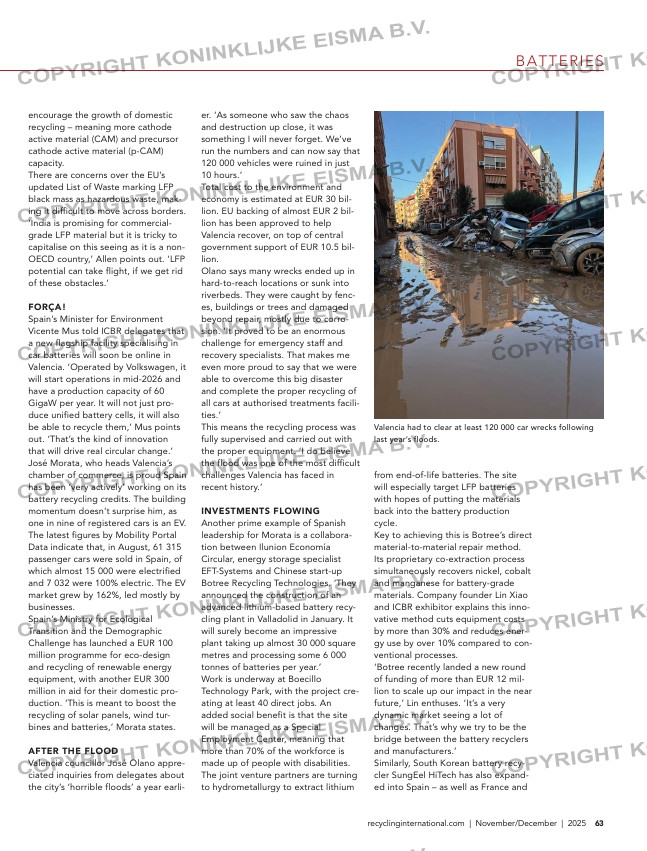
120 000 vehicles were ruined in just
10 hours.’
Total cost to the environment and
economy is estimated at EUR 30 bil-
lion. EU backing of almost EUR 2 bil-
lion has been approved to help
Valencia recover, on top of central
government support of EUR 10.5 bil-
lion.
Olano says many wrecks ended up in
hard-to-reach locations or sunk into
riverbeds. They were caught by fenc-
es, buildings or trees and damaged
beyond repair, mostly due to corro-
sion. ‘It proved to be an enormous
challenge for emergency staff and
recovery specialists. That makes me
even more proud to say that we were
able to overcome this big disaster
and complete the proper recycling of
all cars at authorised treatments facili-
ties.’
This means the recycling process was
fully supervised and carried out with
the proper equipment. ‘I do believe
the flood was one of the most difficult
challenges Valencia has faced in
recent history.’
INVESTMENTS FLOWING
Another prime example of Spanish
leadership for Morata is a collabora-
tion between Ilunion Economía
Circular, energy storage specialist
EFT-Systems and Chinese start-up
Botree Recycling Technologies. ‘They
announced the construction of an
advanced lithium-based battery recy-
cling plant in Valladolid in January. It
will surely become an impressive
plant taking up almost 30 000 square
metres and processing some 6 000
tonnes of batteries per year.’
Work is underway at Boecillo
Technology Park, with the project cre-
ating at least 40 direct jobs. An
added social benefit is that the site
will be managed as a Special
Employment Center, meaning that
more than 70% of the workforce is
made up of people with disabilities.
The joint venture partners are turning
to hydrometallurgy to extract lithium
from end-of-life batteries. The site
will especially target LFP batteries
with hopes of putting the materials
back into the battery production
cycle.
Key to achieving this is Botree’s direct
material-to-material repair method.
Its proprietary co-extraction process
simultaneously recovers nickel, cobalt
and manganese for battery-grade
materials. Company founder Lin Xiao
and ICBR exhibitor explains this inno-
vative method cuts equipment costs
by more than 30% and reduces ener-
gy use by over 10% compared to con-
ventional processes.
‘Botree recently landed a new round
of funding of more than EUR 12 mil-
lion to scale up our impact in the near
future,’ Lin enthuses. ‘It’s a very
dynamic market seeing a lot of
changes. That’s why we try to be the
bridge between the battery recyclers
and manufacturers.’
Similarly, South Korean battery recy-
cler SungEel HiTech has also expand-
ed into Spain – as well as France and
Fotobijschrift
KADERKOP
??
Valencia had to clear at least 120 000 car wrecks following
last year’s floods.
62-63-64-65-66_ibrcreport.indd 63 19-11-2025 11:13


